← Back to Work
Content Hub
Portal redesign and strategy overhaul for Gartner for Marketing Leaders — revisiting both design and overall strategy after an independent firm failed to deliver conversion metrics.

Portal redesign and strategy overhaul for Gartner for Marketing Leaders — revisiting both design and overall strategy after an independent firm failed to deliver conversion metrics.
An independently commissioned portal failed to convert leads — excessive content exposure before lead generation elements, and an IA that made the value proposition unclear.
A content-first redesign organized around three user objectives, with a Solutions Engine that replaced 30-field forms and doubled as a content strategy pulse meter.
Gartner expanded its business strategy to serve marketing professionals through "Gartner for Marketing Leaders" — offering real-time, personalized digital marketing guidance from vision through execution. An independent design firm was commissioned to build a portal, but it failed to deliver the conversion metrics the business needed.
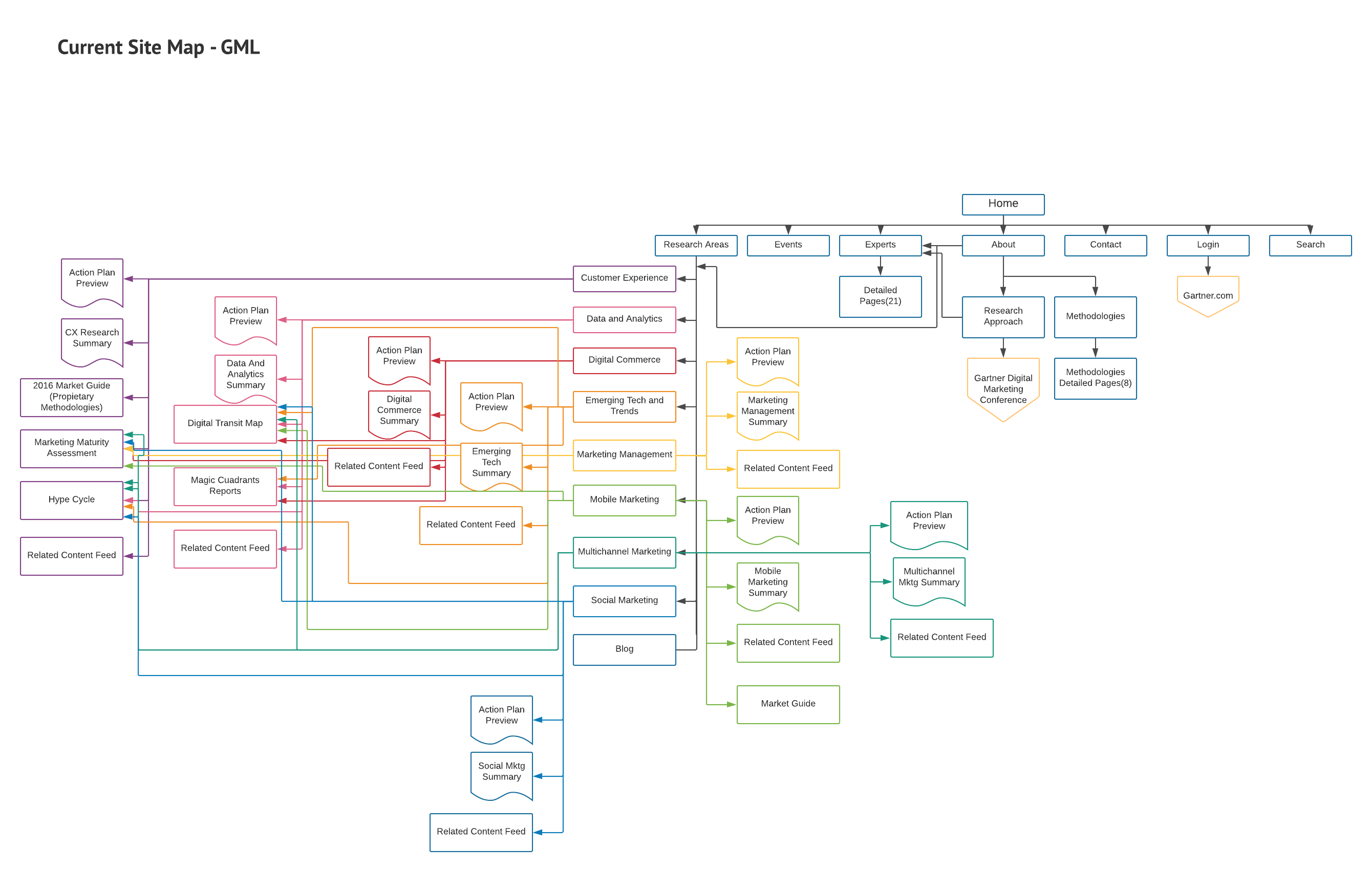
The original site's information architecture made it difficult for users to quickly identify the value proposition. Content was scattered across sections with no clear pathways, and users were exposed to excessive content before finding lead generation elements.
Reducing content exposure before lead generation elements was the key lever. The site needed to communicate its value proposition within seconds of arriving — not after pages of content exploration.
The redesign organized the entire site around three major user objectives: Meeting Our Experts, Exploring Our Methodologies, and Understanding Our Solutions. This dramatically simplified the IA and reduced content exposure before lead generation elements.
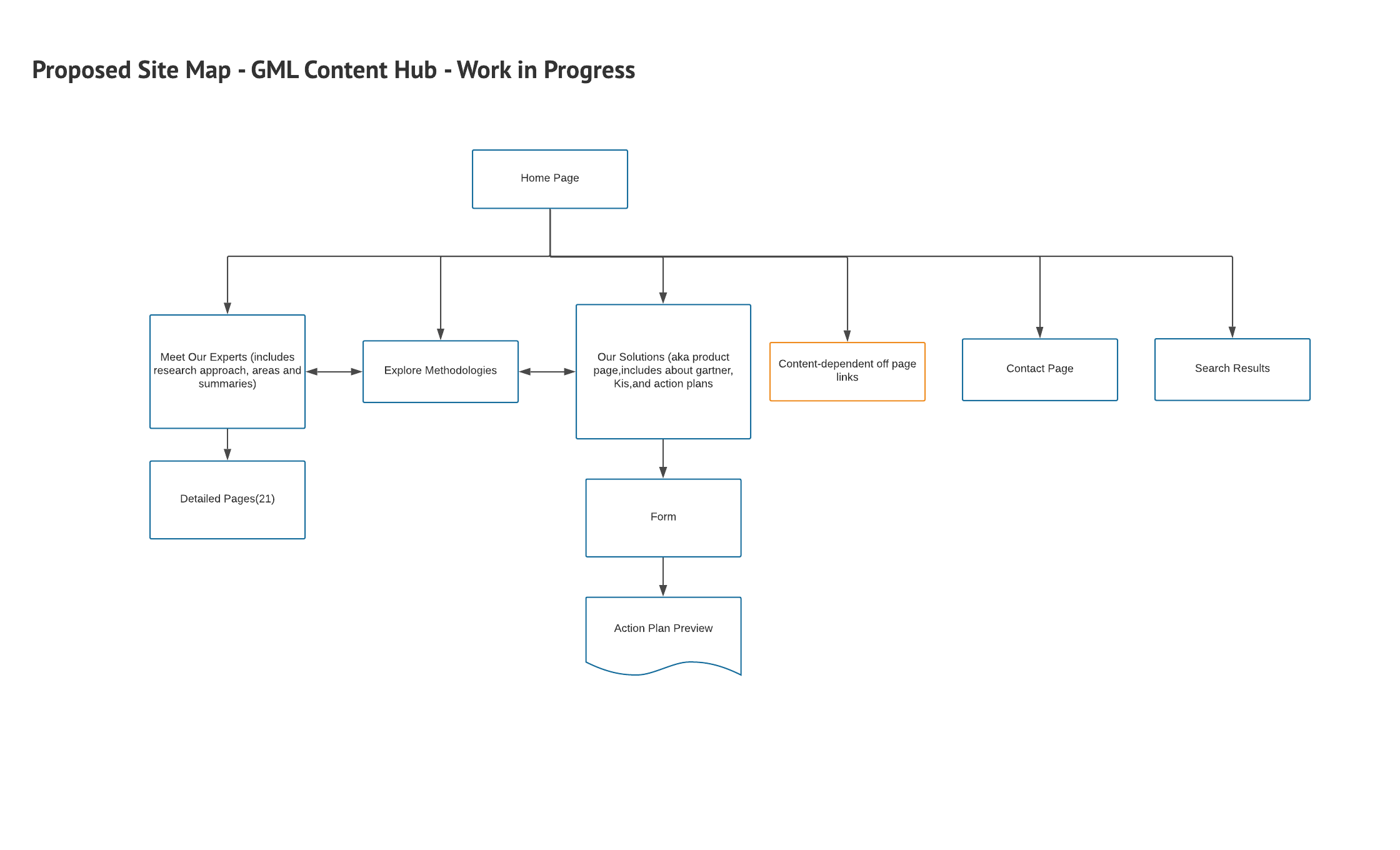
Proposed site map — a cohesive, objective-based hierarchy replacing the fragmented original structure.
Three Clear Paths
Meet Our Experts, Explore Methodologies, and Our Solutions — users can fully understand what Gartner for Marketing Leaders offers by simply scanning the site.
Phased Launch
Rather than a big-bang redesign, the plan addressed immediate lead generation gaps while maintaining site availability and flexibility for future iterations.
Three key design solutions addressed the conversion and content strategy problems.
Homepage — showcasing diverse subjects and formats to position GML as a valuable resource.
Content Hub Homepage
Showcased diverse subjects and formats while maintaining visual clarity. Three-objective navigation ensures users can scan and understand the value proposition immediately.
Topic Filtering
Secondary navigation doubled as a filtering mechanism for users and a data capture tool for analytics — tracking which topics were top-of-mind for visitors.
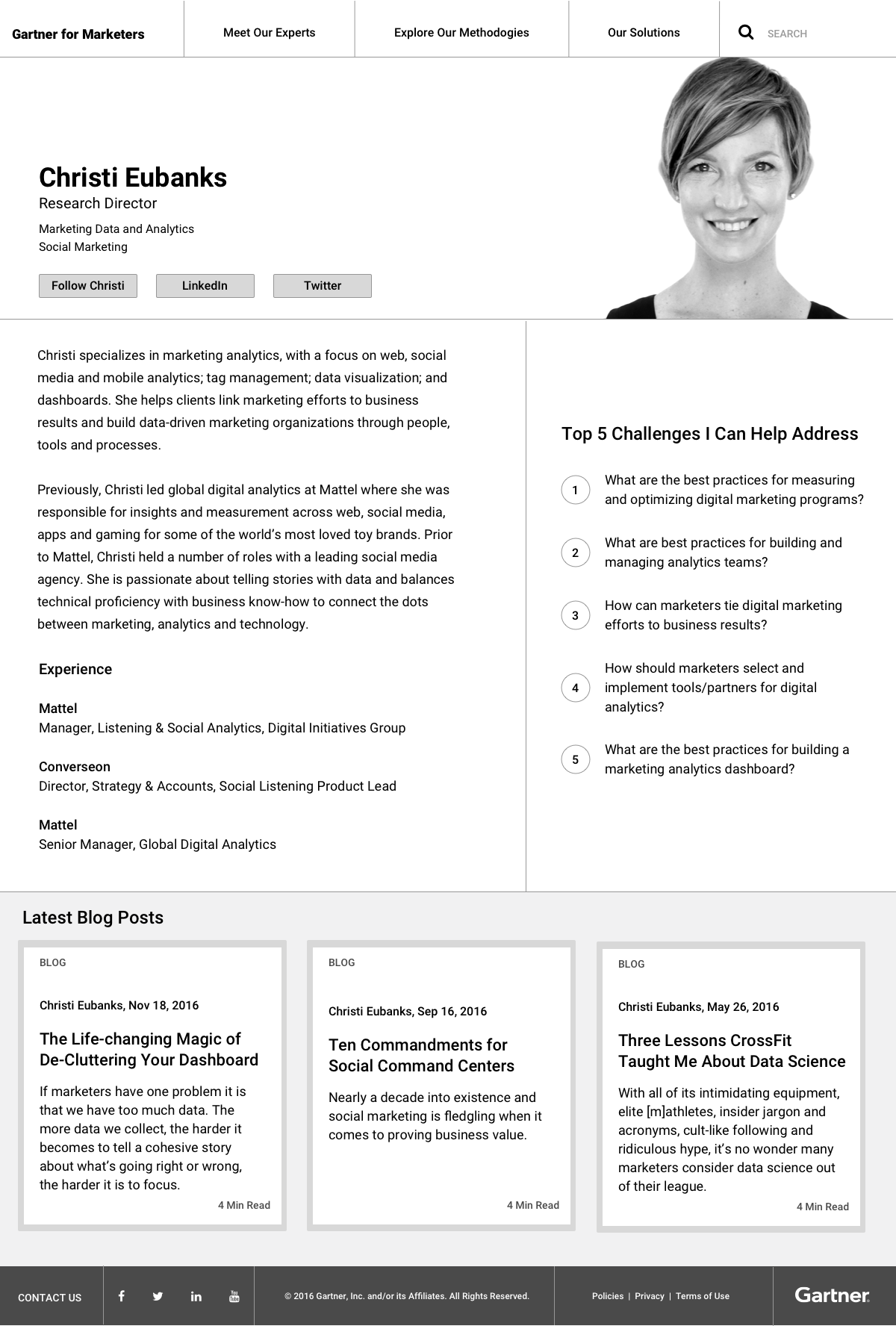
Expert detail page — combining bio with research methodology in one view.
Mini Content Hubs
Combined individual bios with Gartner's research approach — previously scattered across separate site areas, forcing aimless navigation. Social channels positioned prominently above the fold.
Top 5 Challenges
The top 5 challenges each expert addresses highlighted above the fold — showcasing value-add information that influences conversion rather than burying it below.
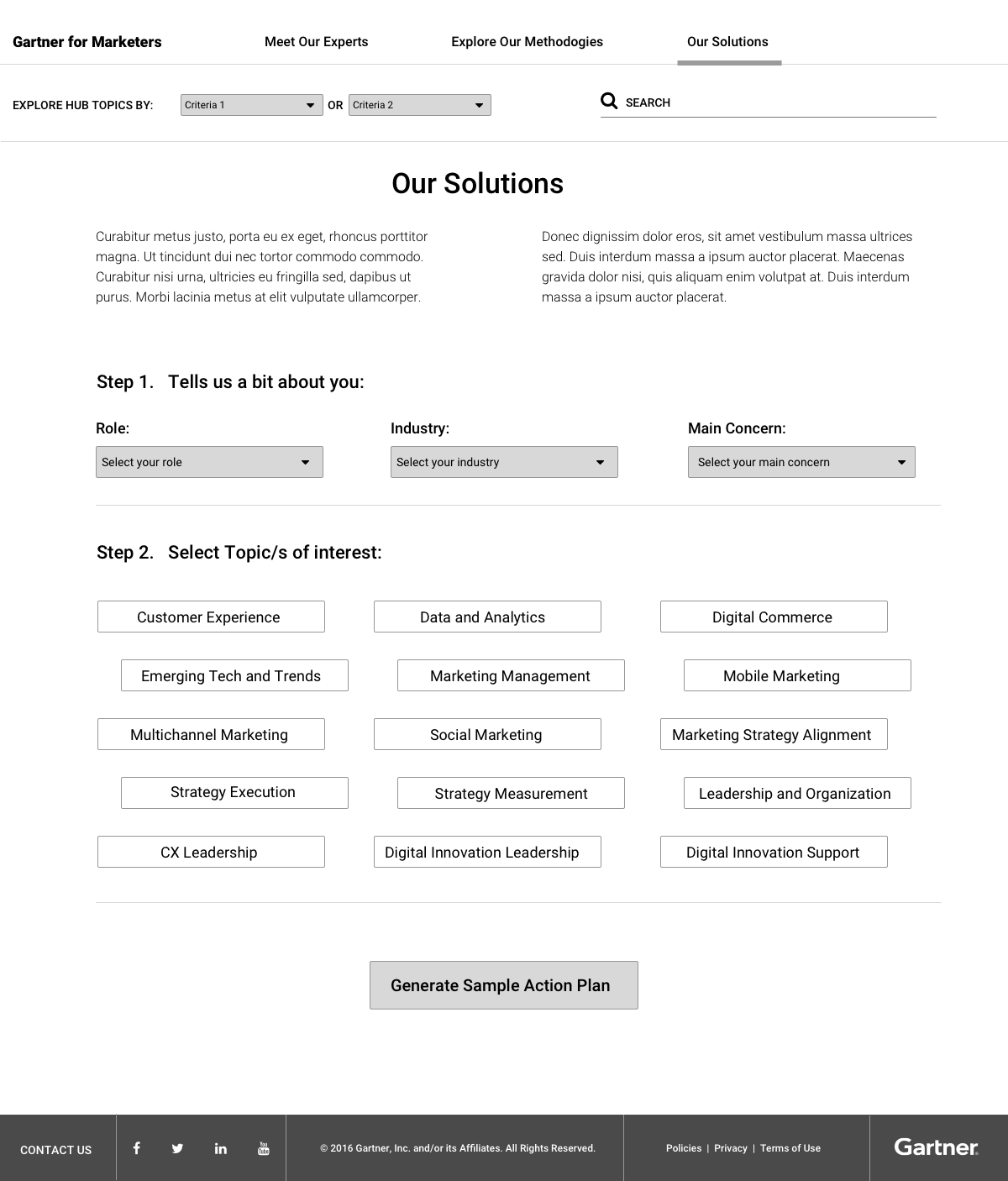
Solutions Engine — replacing 30-field forms with a streamlined 2-step process.
Solutions Engine
Collected minimal key information — role, industry, main concern — then let users select topics of interest from ten major initiatives. Generated customized action plans based on inputs.
Pulse Meter
Beyond lead generation, the engine captured top-of-mind user concerns — serving as a real-time pulse meter for the research and analytics teams to measure content relevance and inform future strategy.
The redesigned Content Hub launched in phases, maintaining site availability throughout. The Solutions Engine delivered dual value — as a lead generation tool producing customized action plans, and as a continuous insight engine for the research organization.
The secondary navigation's filtering data captured top-of-mind concerns, enabling data-driven content creation decisions. What started as a strategy and design overhaul became a tool that measured content relevance in real time — turning lead generation into a feedback loop between users and the research team.
Replaced 30-field forms with minimal data collection. Organized around 10 key initiatives, generating customized action plans — and serving as a pulse meter for the research team.
Combined bio with research methodology on one page. Social channels and top 5 challenges above the fold — previously scattered across separate site areas.
Three clear paths: Meet Our Experts, Explore Our Methodologies, Understand Our Solutions. Secondary nav doubled as analytics filtering for top-of-mind topic capture.
Replacing 30-field forms with minimal data collection improved both completion rates and lead quality — users share more when asked for less.
Three clear paths made the value proposition scannable in seconds. The original site's internal organization was invisible to users.
The Solutions Engine generated leads while capturing top-of-mind concerns — the research team used it to measure content relevance against real user needs.